
Out of the Suitcase #56: Games Workshop and RuneQuest 3rd Edition
Posted by Michael O'Brien on 24th Aug 2026
Chaosium President Rick Meints shares stories from a life-time as a collector of all things Chaosium
RuneQuest 2nd edition ranked as one of the best selling RPGs in the UK in the very early 1980s. Only D&D surpassed it in popularity. Games Workshop (GW) sold and distributed both RuneQuest and D&D under licensing deals from Chaosium and TSR, yet in a larger sense GW effectively sold the majority of most mainstream RPGs in the UK at that time. Between their own chain of stores, a thriving mail order division, and being the largest games distributor in the UK, and publishing White Dwarf, their own general interest RPG Magazine, GW was the big player in the UK RPG market; dwarfing most domestic competitors (pun intended).
When Avalon Hill's RuneQuest 3rd edition debuted in 1984, Games Workshop could no longer sell their own RQ2 rulebook, RQ2 boxed set, or their minis boxed sets, all made in the UK, and saw the market for RuneQuest start to shrink.
The imported Avalon Hill RQ3 boxed set carried a high price tag—about 40 UK pounds—and, because it came in a box, was subject to a 15% sales tax known as VAT (Value Added Tax). Books were exempt from VAT, which led to GW pivoting to publishing their licensed edition of RQ3 as a short-lived series of five books (RuneQuest, Advanced RuneQuest, Monsters, Griffin Island, and Land of Ninja) in 1987.
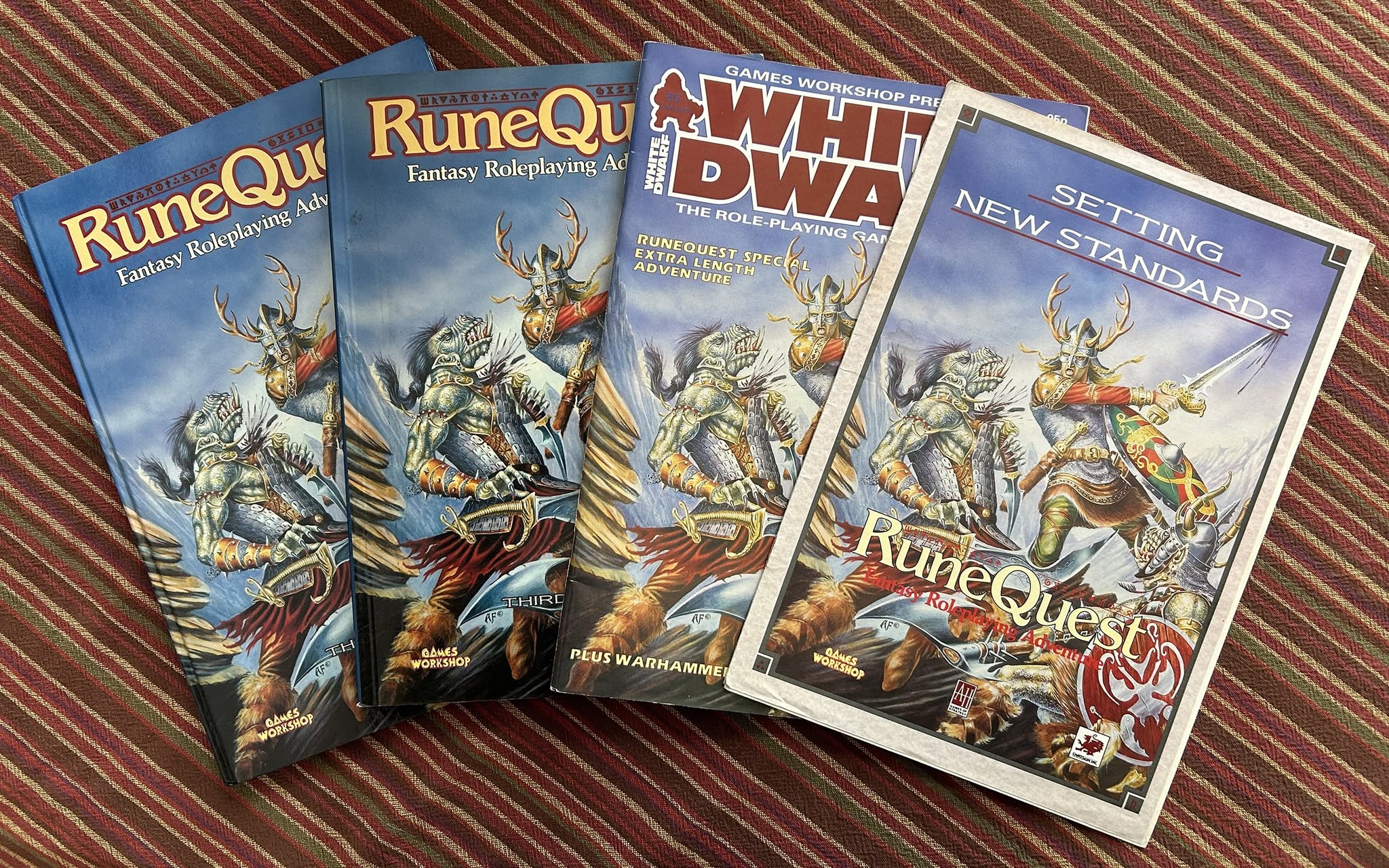
To help announce the debut of their RQ3 hardcover books, GW featured them in White Dwarf #85, the January 1987 issue. Along with a description of the RQ3 system, they included the 16 page "special extra length adventure" A Tale to Tell by Jon Quaife. That scenario would later become a part of the Avalon Hill RQ3 supplement Shadows on the Borderland in 1993, part of the so-called "RuneQuest Renaissance" releases under new RuneQuest editor Ken Rolston. Of note is that GW advertised that it intended to also publish the Vikings supplement as a sixth book, but it was cancelled in late 1987.
The four items pictured above span the four main uses of the Angus Fieldhouse cover art for the RuneQuest Rulebook (1987). Games Workshop also did a softcover version of the rulebook in 1989.
If you want the full story of Games Workshop and its RuneQuest publications, please see my book, MiG3: The Meints Index to Glorantha.